

Integration for greater impact
Eighth Comprehensive evaluation of the GEF
Implementation timelines for integrated programming have improved across GEF replenishment cycles. As of June 2025, 27 percent of GEF-6 child projects remained under implementation, with particularly high rates under the Sustainable Cities Program (42 percent of child projects still ongoing). By comparison, most GEF-7 impact program child projects are currently under implementation, with only a few pending despite CEO endorsement—one SFM drylands project in Kenya and four FOLUR projects in Guatemala, India, Madagascar, and Malaysia.
Nearly all integrated program child projects and stand-alone projects under GEF-6 experienced implementation delays, largely due to the COVID-19 pandemic (figure 6.3). By GEF-7, child projects—particularly those under Food Systems and Sustainable Cities—were less likely to report delays than stand-alone projects, with a particularly notable improvement in Sustainable Cities. In contrast, for the GWP and the SFM program, delay rates were comparable between child and stand-alone projects.
The improved implementation trajectory of integrated program child projects from GEF-6 to GEF-7 reflects both the easing of pandemic-related disruptions and proactive efforts by the GEF and its partners to strengthen project design and streamline child project approval. In particular, clearer definition of roles and responsibilities between coordination units and child projects—supported by more detailed terms of reference—helped establish stronger program governance from GEF-7 onward.
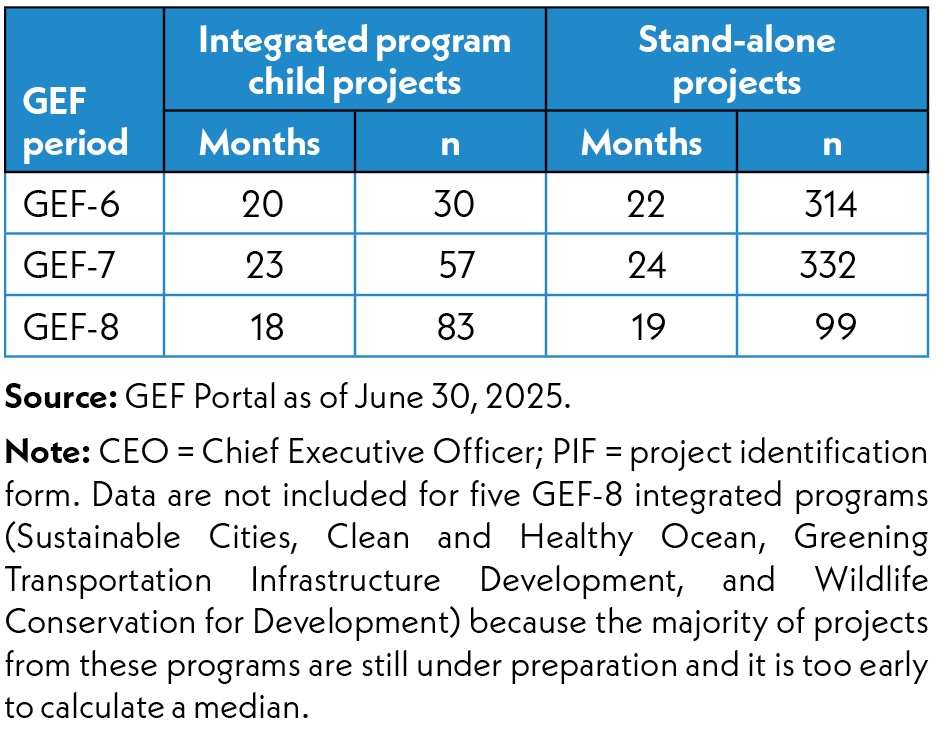
Implementation timelines for integrated program child projects are comparable to, or slightly shorter than, those of stand-alone projects. An analysis of key timeline indicators—such as the time elapsed from project approval to CEO endorsement—shows that integrated program child projects generally reached critical milestones within similar, or in some cases shorter, time frames than stand-alone projects (table 6.7), although the difference was modest (around one month).5
Source: Project implementation reports and midterm reviews.
Note: SFM = sustainable forest management.
In spite of these improvements, integrated programs continue to face implementation challenges. Figure 6.4 presents the findings from a large language model analysis of implementation issues reported for 20 integrated program child projects and 39 stand-alone GEF-7-approved projects comparable in terms of CEO endorsement dates, countries, and focal areas, identifying the typology and frequency of different implementation issues. The analysis found that both sets of projects reported facing similar challenges. For instance, under GEF-7, both modalities struggled with stakeholder coordination. However, some issues appeared to be relatively more prevalent in integrated program child projects—and the differences were statistically significant: financial delays, such as difficulties in securing or disbursing committed funds; limited staff capacity, including technical expertise gaps and recruitment delays; and political disruptions, such as shifts in government priorities, leadership changes, or broader instability. These challenges partly reflect the greater complexity, diversity of partners, and higher technical skill requirements inherent to an integrated program setting, all of which place additional pressure on project teams.
GEF-8 integrated programs are generally well-positioned for timely implementation, with most child projects having already received CEO endorsement (figure 6.5). Notably, newer programs—such as Eliminating Hazardous Chemicals from Supply Chains, Circular Solutions to Plastic Pollution (now Plastic Reboot), and Ecosystem Restoration—have advanced more rapidly than stand-alone projects, partly due to their earlier approval by the GEF Council, which gave them a head start in launching implementation activities.
Performance ratings for project implementation, execution, and monitoring and evaluation (M&E) show minimal differences between closed IAP child projects and stand-alone projects, with one important exception. A review of 22 GEF-6 terminal evaluations found that both project types performed well in implementation and execution quality, with 100 percent of child projects rated in the satisfactory range for both dimensions, compared to slightly lower percentages of stand-alone projects (95 percent for quality of implementation and 91 percent for quality of execution); these differences are not statistically significant. M&E design ratings were also comparable, with 73 percent of child projects and 88 percent of stand-alone projects rated in the satisfactory range, again without significant difference. However, for M&E implementation, IAP child projects performed significantly better, with 100 percent rated in the satisfactory range, compared with 79 percent for stand-alone projects, indicating more consistent application of M&E systems.
In integrated programs, tight timelines have sometimes conflicted with the goal of designing inclusive and well-coordinated child projects. The Food Systems evaluation highlighted the challenge of reconciling the complex, multisectoral nature of food systems transformation with the limited time allowed for project preparation (GEF IEO forthcoming-e). Under GEF-8, Agencies reported that the short timeline set by the GEF Secretariat for submitting expressions of interest and concept notes constrained consultation processes. As a result, some proposals lacked clear input from key government ministries, including those responsible for agriculture and trade, limiting cross-sectoral alignment and potentially affecting national ownership. For programs and child projects aiming to promote behavioral change and drive systemic transformation, insufficient time for stakeholder consultation represents a significant risk.