

Integration for greater impact
Eighth Comprehensive evaluation of the GEF
As global environmental challenges intensify, the ability to manage risk while fostering innovation is increasingly essential for achieving meaningful and lasting impact. For the GEF, the rationale for supporting innovation—particularly through the use of advanced technologies—has never been more compelling. These tools offer the potential to address complex and systemic threats, such as climate change, biodiversity loss, and pollution at scale, where conventional solutions might be insufficient.
To address this need, the GEF has made notable institutional shifts. The GEF-8 Strategic Positioning Framework emphasized innovation as a key driver for transformational change (GEF Secretariat 2022b), supported by the establishment of an Innovation Window and reinforced by the adoption of the 2024 risk appetite statement, which assigns the GEF a high appetite for innovation risk (GEF 2024b; STAP 2022). These developments signal a clear commitment to enabling calculated risk-taking and forward-looking solutions designed to accelerate systemic change.
Risk management in the GEF, however, extends well beyond innovation. Projects must also navigate contextual risks, including climate variability, environmental and social safeguards, and shifting political or governance conditions, as well as execution risks, such as fiduciary oversight, institutional capacity, and challenges to stakeholder engagement. Recognizing these diverse challenges, the GEF Council adopted a risk appetite framework to guide Agencies in taking calculated risks. This framework differentiates risk appetite across three dimensions: innovation risk (high), contextual risk (substantial), and execution risk (moderate). By applying differentiated appetite levels, the framework supports adaptive risk management and learning, enabling projects to pursue systemic and scalable outcomes while maintaining robust mitigation measures (table 9.1).
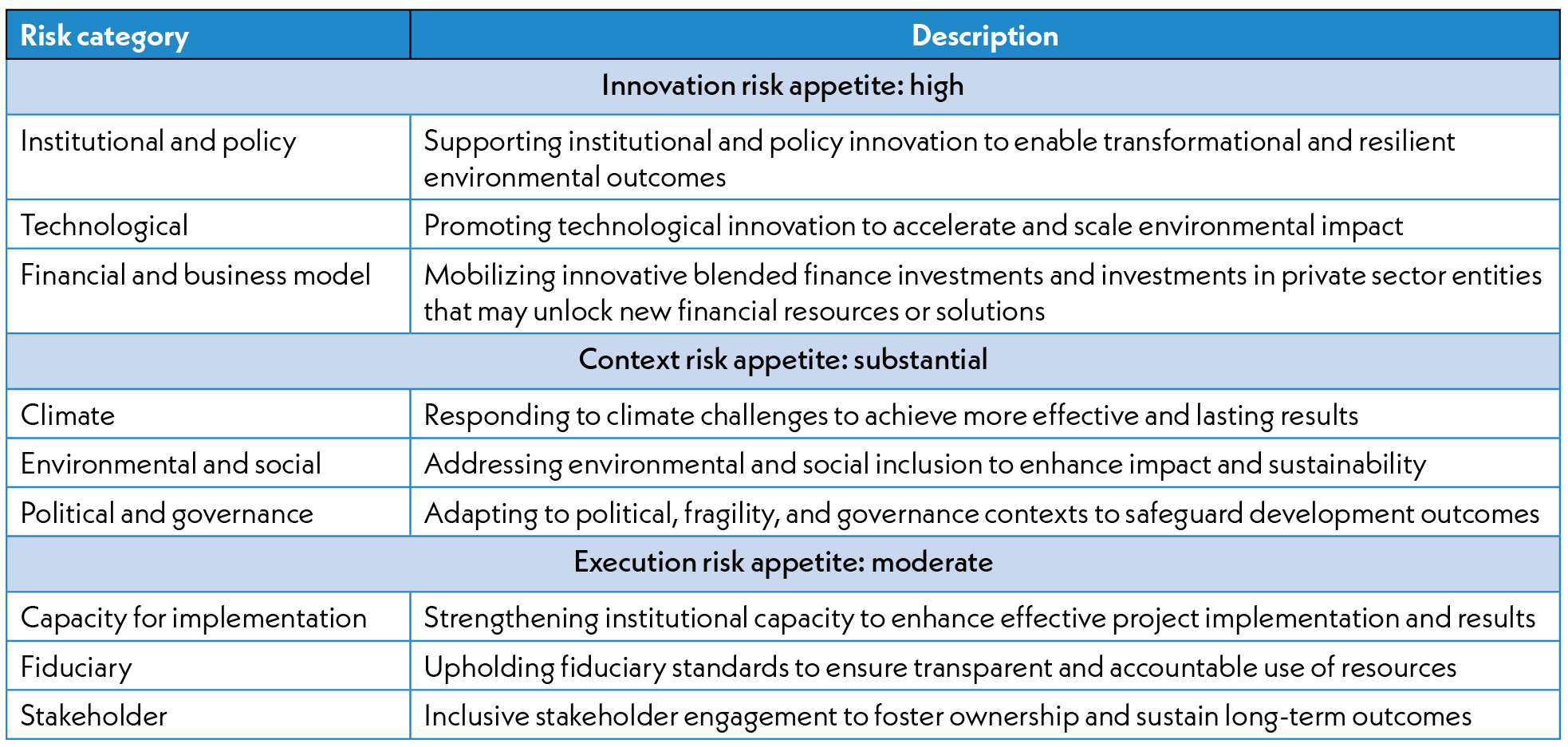
The GEF places particular emphasis on innovation risk, recognizing that transformational change often requires testing unproven solutions. This risk encompasses three areas: institutional and policy risks, arising from political or regulatory shifts; technological risks, linked to the uncertain performance of new or unproven technologies; and financial and business model risks, reflecting the challenges of attracting private investment to novel instruments such as biodiversity credits or blended finance.
While many successful approaches combine different types of innovation, this chapter focuses on technological innovation and its associated risks, reflecting both its high rating in the GEF risk appetite statement and its potential to deliver quick, tangible outputs and attract private sector engagement. Recent years have seen an exponential pace of technological advancement, offering unprecedented opportunities to address environmental challenges at scale. Scientific and policy assessments (e.g., Bierbaum et al. 2024; Lenton et al. 2023; World Economic Forum 2017, 2020, 2021) highlight technological innovation as a key enabler of transformational environmental management, from reducing greenhouse gas emissions and improving natural resource efficiency to curbing pollution and boosting agricultural productivity.
Against this backdrop, this chapter examines risk in the GEF portfolio broadly, with a focus on technological innovation. It draws on two recent evaluations—Assessing Portfolio-Level Risk in the GEF and Evaluation of Innovation and Application of Technologies in the GEF (GEF IEO forthcoming-b, forthcoming-l)—to explore how risk and innovation ambitions are being translated into practice, what enabling conditions are needed, and which barriers remain.